
Table of contents
Astronomers and astrophysicists around the globe have spent decades listening to the quiet vastness of the universe. For the most part, the cosmos responds with a faint, predictable backdrop of radiation left behind by the Big Bang. However, every so often, our radio telescopes capture a whisper or a sudden, loud burst originating from millions or even billions of light-years away. These enigmatic emissions, commonly known as ancient deep space signals, have captivated the scientific community and the public alike. They represent some of the most intense, unexplained energy release events in modern astrophysics, raising profound questions about the nature of space, time, and the extreme physics governing distant galaxies.
Understanding these signals requires diving deep into observational astronomy, high-energy astrophysics, and theoretical modeling. As detection techniques become more sophisticated, the number of captured anomalies increases, yet each discovery seems to bring as many new questions as it does answers. Are these transmissions the lingering thermal signatures of dying stars, the extreme manifestations of magnetars, or something entirely unknown to contemporary science? To grasp the magnitude of this cosmic puzzle, one must examine the history, physics, and potential causes of these mysterious galactic emissions.
1. The Genesis of Radio Astronomy and Early Cosmic Detections
The pursuit of deep space signals did not begin with modern supercomputers or orbital observatories. It originated in the early 20th century when Karl Jansky, an engineer at Bell Telephone Laboratories, built a large directional antenna to investigate sources of static that were interfering with transatlantic radio communications. In 1932, Jansky identified a persistent, faint hiss that moved across the sky once every sidereal day. He concluded that this noise was not coming from Earth or the Sun, but from the heart of the Milky Way galaxy.
Jansky’s discovery laid the groundwork for radio astronomy, establishing that the universe emits energy outside the visible light spectrum. Decades later, during the mid-to-late 20th century, scientists began building massive radio dishes, such as the Arecibo Observatory in Puerto Rico and the Parkes Observatory in Australia. These instruments allowed researchers to scan deep space with unprecedented sensitivity, revealing pulsars, quasars, and radio galaxies. Yet, among these predictable radio sources, certain anomalous signals stood out due to their sheer intensity, brief duration, or unusual repetition patterns.
2. Fast Radio Bursts: The Modern Deep Space Enigma
Among all detected cosmic emissions, Fast Radio Bursts (FRBs) are arguably the most perplexing. First discovered in 2007 by researchers analyzing archival data from the Parkes Observatory, FRBs are millisecond-duration flashes of radio waves originating from distant extragalactic sources. Despite lasting only a tiny fraction of a second, a single FRB can unleash more energy in a millisecond than our Sun produces over several days or weeks.
What makes FRBs particularly challenging to study is their fleeting nature. Unlike traditional stars or galaxies that can be pointed at and analyzed continuously, an FRB appears suddenly at a random coordinate in the night sky and disappears almost instantly. Initially, many astronomers questioned whether FRBs were mere terrestrial interference such as microwave ovens opening prematurely near radio receivers or genuine deep space phenomena. However, subsequent observations using multiple independent facilities confirmed that FRBs are indeed cosmological in origin, traveling across billions of light-years before reaching Earth.
3. Dispersion Measure: Calculating Distance Across Cosmic Time
To confirm that a radio signal has traveled across vast cosmic distances, astrophysicists rely on a critical property called dispersion measure (DM). As radio waves travel through the interstellar and intergalactic medium, they interact with free electrons scattered throughout space. Higher-frequency radio waves travel slightly faster through this ionized gas than lower-frequency waves.

When a radio telescope detects a deep space signal, the higher frequencies arrive a few milliseconds before the lower frequencies. By measuring this time delay across different frequencies, astronomers can calculate the total column density of electrons the signal passed through. A higher dispersion measure indicates that the signal has encountered a vast amount of intergalactic material, proving that its origin lies far beyond the boundaries of the Milky Way galaxy. In many cases, dispersion measurements place the origin of these signals billions of light-years away, meaning the radio waves were emitted when the Earth was still in its earliest stages of formation.
4. Primary Theories Behind Mysterious Deep Space Signals
Scientists have proposed several theoretical models to explain the mechanisms capable of producing such extreme bursts of energy. Because the conditions required to generate high-energy radio waves in millisecond bursts are extreme, only the most violent astrophysical environments are considered plausible candidates.
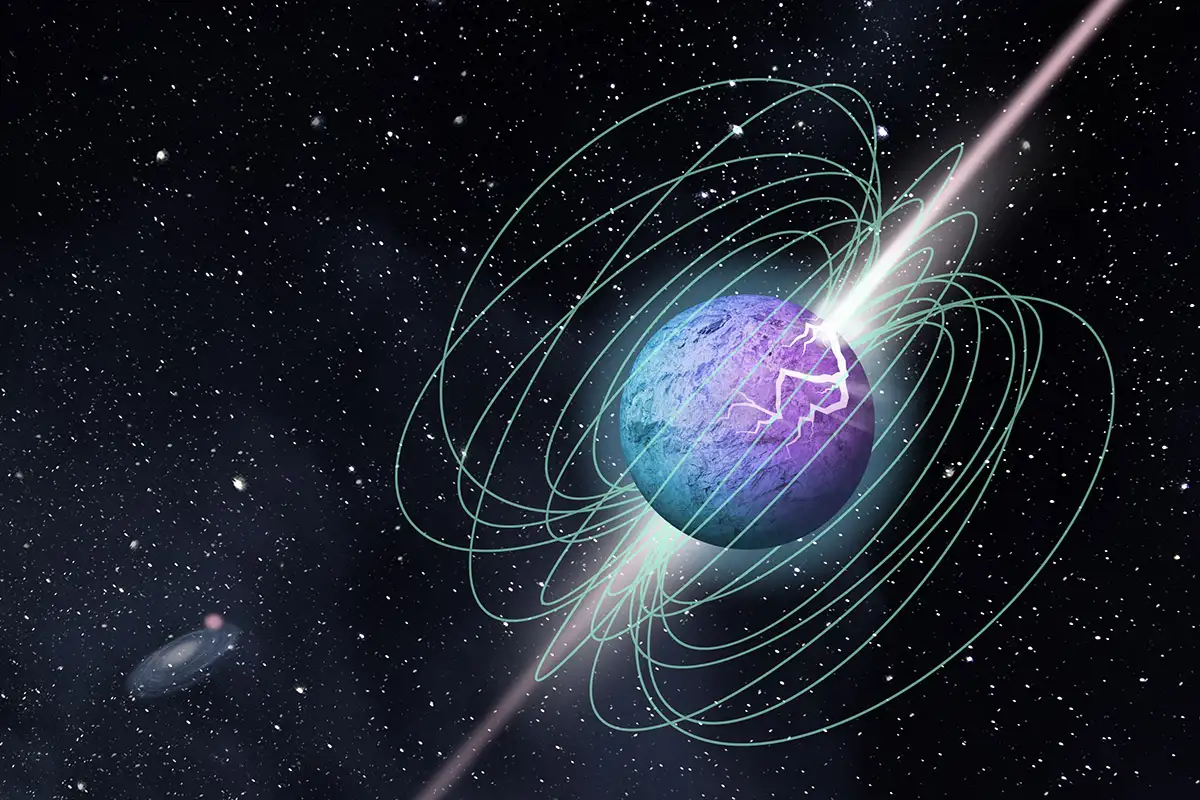
A. Magnetars and Highly Magnetized Neutron Stars Neutron stars are the ultra-dense remnants left behind after massive stars undergo supernova explosions. A specialized class of neutron stars, known as magnetars, possesses magnetic fields trillions of times stronger than Earth’s. When a magnetar experiences a “starquake”—a structural cracking of its crystalline crust under intense magnetic stress—it releases massive amounts of energy. In recent years, researchers observed a weak FRB-like emission originating from a magnetar within our own galaxy (SGR 1935+2154), providing strong empirical evidence that magnetars are at least one confirmed source of these bursts.
B. Merging Compact Objects Another hypothesis involves catastrophic cosmic collisions. When two neutron stars orbit each other, they gradually lose orbital energy through gravitational waves until they collide and merge into a single black hole. A similar process occurs when a neutron star merges with a black hole. These violent collisions unleash immense kinetic and magnetic energy, potentially firing off a single, non-repeating radio pulse right before the progenitor objects collapse.
C. Cosmic Strings and Primordial Black Holes More exotic theoretical explanations invoke cosmological phenomena dating back to the early universe. Cosmic strings are hypothetical, one-dimensional topological defects in the fabric of spacetime formed during early phase transitions. If a cosmic string snaps or forms a loop, it could release massive bursts of electromagnetic radiation. Similarly, the final explosive evaporation of primordial black holes—hypothetical mini black holes created shortly after the Big Bang—could manifest as powerful, short-lived radio bursts.
D. Extraterrestrial Technological Activity While mainstream scientists view natural astrophysical explanations as the most probable, the hypothesis of artificial origin remains a topic of scientific debate within search for extraterrestrial intelligence (SETI) circles. Some theoretical physicists have calculated that hyper-advanced civilizations could theoretically construct solar-powered beam arrays to propel giant light sails across interstellar distances. Leakage from such high-powered directional beams sweeping past Earth might mimic the observational characteristics of repeating radio signals.
5. Repeating vs. Non-Repeating Signals: A Divergence in Physics
As observational data expanded, astronomers discovered a fundamental division among deep space radio bursts: some appear once and never occur again, while others repeat periodically from the exact same point in the sky.
A. Non-Repeating Bursts The vast majority of detected signals fall into the non-repeating category. A radio pulse flares up for a millisecond and then goes completely silent. This behavior suggests a cataclysmic origin—a singular, destructive event such as a stellar collision, a supernova collapse, or a neutron star falling into a black hole. Once the object is destroyed during the event, no subsequent signals can be generated.
B. Repeating Bursts In 2016, researchers confirmed that FRB 121102 was actively repeating, firing off dozens of high-energy bursts over several months. Repeating signals rule out cataclysmic destruction as the sole cause for all FRBs, as the source object obviously survives each burst. Furthermore, some repeating sources demonstrate predictable activity cycles. For example, one repeating source was observed emitting bursts during a 90-day window, followed by 67 days of complete silence, repeating this cycle continuously. This periodicity suggests orbital motion, such as a magnetar orbiting a massive star or interacting with a dense dust disk.
6. Key Scientific Anomalies and Historical Case Studies
Over the past half-century, a few specific deep space detections have achieved legendary status due to their peculiar properties and unresolved origins.
A. The Wow! Signal (1977) On August 15, 1977, the Big Ear radio telescope at Ohio State University recorded a exceptionally strong narrowband radio signal lasting 72 seconds. Discovered by astronomer Jerry R. Ehman, the signal was so unusual that he circled the alphanumeric code “6EQUJ5” on the computer printout and wrote “Wow!” next to it. The signal occurred at 1420 MHz, the fundamental emission frequency of neutral hydrogen—a frequency often suggested by SETI researchers as an ideal interstellar communication channel. Despite decades of continuous search efforts, the Wow! Signal has never been detected again, leaving its origin unexplained.
B. The Lorimer Burst (FRB 010724) Discovered in 2007 during an archival search of data collected by the Parkes Observatory in 2001, the Lorimer Burst was the very first Fast Radio Burst ever identified. It displayed a massive dispersion measure, proving it originated far outside the Milky Way. The sheer energy and short duration of the Lorimer Burst forced astrophysicists to recognize a completely new category of cosmic phenomena.
C. FRB 20190520B: The Deep Space Repeater Discovered by the Five-hundred-meter Aperture Spherical radio Telescope (FAST) in China, this repeating burst raised intense curiosity because it was found to reside in a highly complex plasma environment within a dwarf galaxy. Unlike many other bursts, FRB 20190520B is continuously active, emitting persistent background radio noise between major bursts, suggesting an environment surrounded by extreme magnetic fields and dense surrounding debris.
7. The Technological Breakthroughs Driving Modern Discoveries
The rapid acceleration of deep space signal discoveries over recent years is largely driven by revolutionary advancements in radio telescope design, digital signal processing, and artificial intelligence.
A. Wide-Field Radio Telescopes Traditional radio dishes focused on a tiny patch of sky at any given time, making the detection of random, millisecond-long signals statistically improbable. Modern observatories, such as the Canadian Hydrogen Intensity Mapping Experiment (CHIME), feature unique cylindrical reflectors with no moving parts. CHIME uses massive computing power to reconstruct digital beams, allowing it to monitor vast swaths of the northern sky simultaneously and capture thousands of bursts that previous telescopes would have missed.
B. Machine Learning and Automated Detection Modern radio observatories generate terabytes of raw data every hour. Searching through these massive datasets manually for faint, dispersed pulses is humanly impossible. Advanced machine learning algorithms and convolutional neural networks are now trained to scan incoming observational streams in real-time. These automated systems can instantly differentiate between terrestrial radio interference and genuine cosmological pulses, triggering immediate follow-up observations from optical, X-ray, and gamma-ray observatories worldwide.
C. Interferometry and Sub-Arcsecond Localization One of the historical difficulties in understanding deep space signals was poor spatial resolution; a single radio dish could only narrow down a signal’s position to a broad region containing thousands of distant galaxies. By combining multiple dishes spread across hundreds or thousands of kilometers—a technique called Very Long Baseline Interferometry (VLBI)—astronomers can pinpoint the exact host galaxy and even the specific neighborhood where a burst originated.
8. What Deep Space Signals Tell Us About the Universe
Studying these ancient radio signals is not merely about identifying their sources; it is also about using them as cosmological probes to study the large-scale structure of the cosmos.

A. Resolving the Missing Baryon Problem For years, cosmological models predicted that a certain amount of ordinary matter (baryons) should exist in the universe. However, optical surveys of stars and galaxies could only locate about half of this predicted matter. Scientists suspected the missing matter was hidden in the warm-hot intergalactic medium as diffuse, low-density plasma. Because radio signal dispersion directly measures the electron density along the line of sight, scientists used FRB dispersion measures to confirm the presence of this hidden intergalactic gas, successfully resolving the missing baryon problem.
B. Mapping Intergalactic Magnetic Fields As radio waves pass through magnetized regions of space, their polarization orientation rotates—a process known as Faraday rotation. By measuring the degree of Faraday rotation in deep space signals, astrophysicists can map the strength and structure of magnetic fields existing between galaxies, shedding light on how magnetic forces shaped cosmic structure during the early universe.
C. Testing Fundamental Physics and Einstein’s Relativity Deep space signals serve as natural laboratories for testing fundamental physics. Because these bursts travel across billions of light-years, scientists can use them to test Einstein’s Equivalence Principle by verifying whether photons of different energies travel at the exact same speed through gravitational fields over long durations. Any observed deviation would provide groundbreaking evidence of new physics beyond the Standard Model.
9. Future Observatories and the Next Frontier in Radio Astronomy
The investigation into ancient space signals is entering a golden era, backed by next-generation astronomical infrastructure designed to scan the skies with unparalleled sensitivity.
A. The Square Kilometre Array (SKA) Currently under construction across radio-quiet regions of South Africa and Australia, the Square Kilometre Array will become the world’s largest radio telescope network. Combining thousands of dishes and low-frequency antennas, the SKA will possess unprecedented sensitivity, capable of detecting millions of FRBs, discovering thousands of new pulsars, and potentially detecting fainter signals from the far reaches of the observable universe.
B. Deep Synoptic Array (DSA-110 and DSA-2000) Located in California, the Deep Synoptic Array project aims to deploy hundreds of dishes optimized specifically for detecting and instantaneously localizing radio bursts. By pinpointing thousands of bursts to their precise host galaxies, the DSA will help scientists determine whether different classes of bursts originate from distinct populations of host galaxies.
10. Conclusion: The Ongoing Quest for Answers
The ongoing mystery of ancient deep space signals reminds us how much of the universe remains unexplored. From the early detections of cosmic static in the 1930s to the modern, automated identification of fast radio bursts, each breakthrough has altered our understanding of high-energy physics and cosmology.
Whether these signals turn out to be the energetic screaming of magnetars cracking under immense magnetic fields, catastrophic collisions of compact objects, or phenomena completely unimaginable within current theoretical models, they serve as crucial clues to unraveling the fundamental laws of nature. As next-generation telescopes come online, scientists move closer to transforming these mysterious cosmic whispers into clear chapters of our astronomical history.