Table of contents
For millennia, human civilization has looked upon the great stone monuments of ancient Egypt with a mixture of reverence, awe, and deep intellectual perplexity. Standing prominently across the desert landscape, the massive pyramids most notably those located along the Giza Plateau—represent some of the most extraordinary structural achievements in human history. For centuries, historians, architects, structural engineers, and scientific researchers have wrestled with a fundamental question: How did an ancient civilization, operating without modern combustion engines, hydraulic cranes, iron tools, or heavy industrial machinery, extract, transport, and stack millions of heavy limestone and granite blocks to build these gigantic monuments?
Recent scientific breakdowns, satellite imagery breakthroughs, and advanced geological core samplings have finally provided concrete answers to this age-old debate. The resolution of this puzzle does not lie in mythical phenomena or extraterrestrial intervention, but rather in sophisticated ancient hydrological management, highly efficient logistics networks, master-level stone masonry, and brilliant structural engineering. By utilizing the natural forces of the Nile River alongside ingenious physical mechanics, ancient Egyptian builders constructed a supply chain system that allowed them to move multi-ton stones across long distances with remarkable speed and precision.
The Scale and Physical Reality of Pyramid Construction
To fully comprehend the engineering feat behind these ancient monuments, one must first examine the physical dimensions and raw material demands involved in constructing a landmark like the Great Pyramid of Khufu. Built during the Fourth Dynasty of the Old Kingdom, this structural marvel stood as the tallest man-made building in the world for over 3,800 years.
A. Massive Material Quantities: The Great Pyramid alone contains an estimated 2.3 million individual stone blocks. The majority of these blocks consist of local yellow limestone, with each block weighing between 2.5 to 5 tons on average.
B. Heavy Granite Transport: The internal chambers, including the King’s Chamber, utilize massive rose granite beams sourced from Aswan. Some of these individual ceiling beams weigh up to 50 to 80 tons each and had to be raised dozens of meters into the structure.
C. Precision Alignment: The base of the Great Pyramid covers over 13 acres, yet its sides align to the cardinal points of the compass (North, South, East, West) with an accuracy of within one-fifteenth of a single degree.
D. Time Constraints: Historical records and archaeological findings suggest that the Great Pyramid was completed over a period of roughly 20 years during the reign of Pharaoh Khufu, meaning workers had to place a block into position every few minutes during active work shifts.
The Breakthrough Discovery: The Lost Ahramat Branch
For generations, a major logical flaw plagued theories regarding stone transportation: the main channel of the Nile River currently flows several kilometers away from the primary pyramid fields of Giza, Saqqara, and Dahshur. Dragging millions of multi-ton blocks across miles of dry, scorching desert sand using human muscle alone would have been inefficient and virtually impossible within the observed construction timelines.
The puzzle was solved through satellite radar imaging and deep soil core analysis, which revealed the long-buried footprint of an extinct tributary of the Nile River, officially named the Ahramat Branch (“Ahramat” meaning pyramids in Arabic).

Hydrological Infrastructure and Waterways
A. Natural Water Highway: During the Old Kingdom period (circa 2700–2200 BCE), the Ahramat Branch flowed directly past the foot of thirty-one different pyramids across the western desert plateau. This river branch was deep and wide enough to navigate heavy cargo vessels loaded with stone blocks.
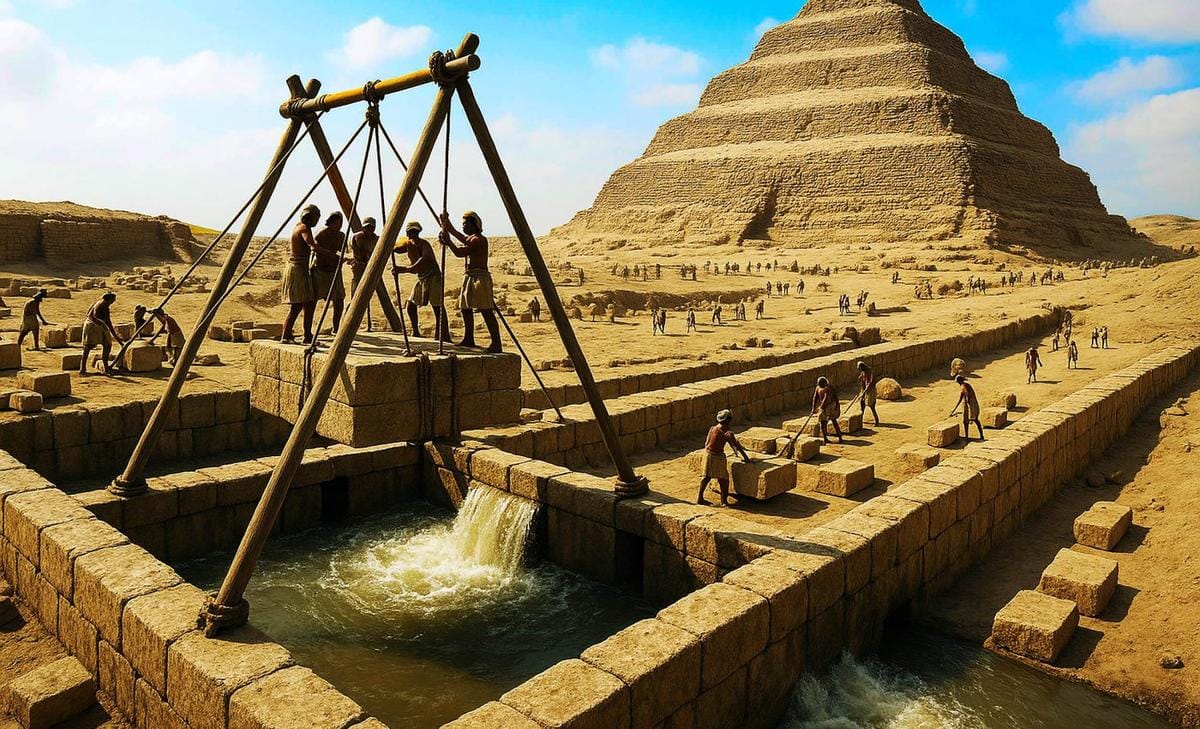
B. Harbor and Basin Systems: Excavations at the base of the Giza Plateau revealed ancient harbor structures, massive retaining walls, and artificial docking basins. These engineering works allowed cargo ships to berth right at the construction sites.
C. Seasonal Flood Utilization: The Egyptians strategically scheduled heavy transport operations during the annual Nile inundation (Akhet season). Rising water levels flooded the artificial canals, increasing water depth and permitting heavy-barges to dock close to the pyramid bases.
D. Climatic Shift and Disappearance: Over centuries, severe droughts and climate shifts led to the drying up and silting of the Ahramat Branch, burying the riverbed under thick desert sands and hiding this vital water transportation route from modern eyes.
Transportation Mechanics: Dragging and Sliding Heavy Blocks
While water networks solved the long-distance transport challenge from quarries in Aswan and Tura to the construction sites, workers still needed to move the massive blocks from the harbor basins onto the actual building ground.
A. Sledges and Friction Reduction: Stone blocks were secured onto large wooden sledges with heavy rope ties. Rather than using wheeled carts, which would sink and stall in the soft desert sand, workers dragged these sledges along specially prepared pathways.
B. The Water-Lubrication Technique: For years, historians pondered how human teams could pull such heavy loads without burning out their strength. Wall paintings found in ancient tombs—such as the famous depiction in the tomb of Djehutihotep—show a worker pouring water onto the sand directly ahead of a moving sledge.
C. Physics of Wet Sand: Modern scientific testing by physicists has confirmed that adding a precise amount of water to sand reduces friction by roughly 50 percent. The water drops form capillary bridges between the sand grains, increasing the stiffness of the ground and preventing sand from piling up in front of the sledge.
D. Paved Causeways: Main transport corridors were surfaced with stiff clay, limestone dust, and wooden crossbeams, forming slippery tracks that minimized pull resistance for the workforce.
Ramp Architecture and Elevation Methods
Lifting millions of heavy stone blocks hundreds of feet into the air remains one of the most debated aspects of ancient engineering. However, recent discoveries at sites such as Hatnub—an ancient alabaster quarry—have shed light on the exact mechanisms utilized by ancient builders.
A. External Straight Ramps: Used primarily during the initial stages of construction to move large volumes of material to the lower tiers of the pyramid.
B. Internal and Spiral Ramps: As the structure grew taller, straight ramps became impractically long and steep. Builders transitioned to helical or spiraling ramps wrapped around the exterior or built within the core walls of the pyramid.
C. Pulley-Free Lever Systems: Without iron or modern pulley wheels, ancient workers utilized wooden posts, rocker sledges, and heavy levers (shadoof-style mechanisms) to nudge and shift blocks upward tier by tier.
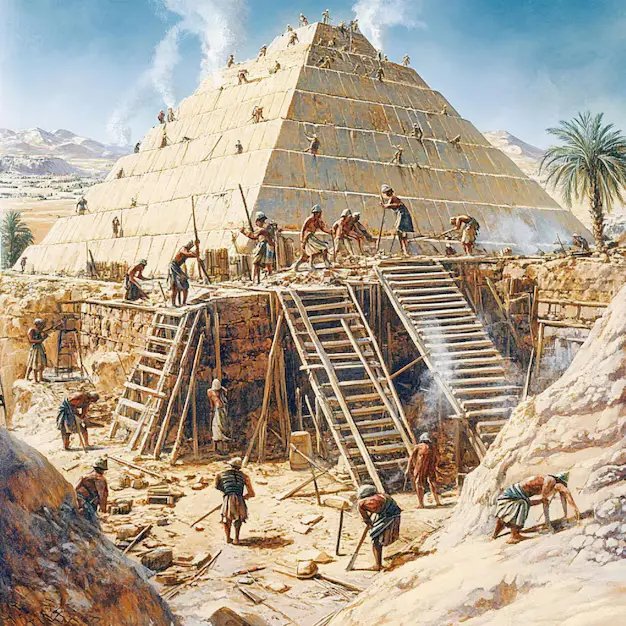
D. Counterweight Systems: Quarries reveal steep ramps flanked by dual staircases lined with wooden postholes. Workers likely used counterweight sledges descending one side to pull stone-laden sledges up the opposing incline, reducing the human energy required.
Stone Cutting, Quarrying, and Surveying Techniques
The accuracy with which the Egyptians cut and aligned stone blocks continues to impress modern engineers. Without hardened steel or iron, craftsmen relied on natural materials, patience, and meticulous geometric methods.
A. Copper Chisels and Wooden Wedges: Soft limestone was quarried using copper chisels, wooden mallets, and wooden wedges soaked in water, which expanded to split rock cleanly along natural fault lines.
B. Dolerite Hammerstones: Hard granite from Aswan was worked using heavy balls of dolerite—a tough, dense rock. Workers repeatedly struck the granite face to pulverize the stone into powder, gradually shaping massive structural beams.
C. Water Leveling Lines: To ensure a perfectly flat foundation, engineers cut a grid of shallow trenches into the bedrock, filled them with water, marked the water level along the trench walls, and then drained the water before carving the rock down to the line.
D. Stellar Alignment: Builders used simple sighting tools called the merkhet and bay to track the rotation of circumpolar stars (such as the North Star), allowing them to align the walls of the pyramid to true north with near-zero margins of error.
Workforce Structure: Refuting the Slave Myth
Popular culture often depicts pyramid construction as the product of brutal slave labor under the whip of harsh overseers. Archaeological evidence uncovered at the Builders’ Town in Giza paints a completely different picture.
A. Paid National Labor Force: The builders were organized, skilled workers and seasonal agricultural laborers who worked on the pyramids during the flood months when farming was impossible.
B. Advanced Logistics and Catering: Animal bone remains found in worker villages indicate that builders were fed high-quality beef, bread, and beer, receiving a nutrient-rich diet to sustain hard physical labor.
C. Medical Care: Skeletal remains show evidence of successfully healed bone fractures, brain surgery (trepanation), and amputations, indicating that workers had access to advanced medical treatment for the era.
D. Pride and Team Identity: Inscriptions inside the Great Pyramid reveal that work gangs gave themselves prideful names like “Friends of Khufu” and competed against one another for speed, precision, and quality.
Summary of Key Technical Factors
| Aspect | Ancient Technique / Discovery | Modern Scientific Finding |
| Long-Distance Transport | Utilization of the extinct Ahramat Nile Branch | Satellite radar imagery mapped a lost 64km river channel right beside pyramid bases |
| Local Ground Transport | Sledges pulled across wet sand | Adding water creates capillary bridges, cutting sand friction by roughly 50% |
| Vertical Lifting | Dual-stair ramps with postholes and internal spirals | Pulley-free counterweight systems reduced lifting force requirements |
| Foundation Leveling | Water-filled trench grids cut into bedrock | Achieved flatness within millimeters across a 13-acre footprint |
| Workforce Model | Organized seasonal labor supported by state logistics | Worker village excavations show high-protein diets and advanced medical care |
The Legacy of Ancient Egyptian Innovation
The resolution of the Egyptian pyramid construction mystery highlights a fundamental truth about human history: ingenuity, keen environmental observation, and organized teamwork can accomplish feats that seem impossible to modern eyes. By turning the natural seasonal patterns of the Nile River into a high-capacity transport engine and leveraging fundamental principles of physics and geometry, the ancient Egyptians created timeless monuments that have survived thousands of years. The discovery of the Ahramat Branch and the physics of water-lubricated sand reminds us that ancient societies possessed deep scientific understanding, enabling them to build enduring wonders through master-level organization and engineering skill.